Zero Trust Architecture with Policy-as-Code
Learn to build and enforce Zero Trust principles in your deployments using policy-as-code as the foundation for your decision-making engine.
📋 Prerequisites
- Expertise in cloud networking, identity management (IAM), and security controls.
- Deep understanding of OPA/Rego for policy-as-code.
- Familiarity with identity providers (IdP), service meshes, and API gateways.
- Knowledge of device posture and endpoint management concepts.
What You'll Learn
🏷️ Topics Covered
💡 "Never Trust, Always Verify"
Zero Trust is a security model that rejects the outdated idea of a trusted internal network. Instead, it treats every access request as if it originates from an open network. Trust is never implicit; it must be continuously evaluated and explicitly granted based on a dynamic, context-aware policy.
The Core Principles of Zero Trust
The entire Zero Trust model is built on three foundational principles. Policy-as-code is the mechanism that allows you to implement and automate them at scale.
Assume Breach
Operate as if an attacker is already inside your network. This eliminates the concept of a "trusted" internal zone and forces you to minimize the blast radius of any potential compromise through micro-segmentation.
Verify Explicitly
Always authenticate and authorize based on all available data points: user identity, device health, location, workload identity, and data classification. Never trust any single factor implicitly.
Least Privilege Access
Grant users and services only the bare minimum permissions they need to perform their function (Just-in-Time and Just-Enough-Access). Access should be segmented by default and granted on a per-session basis.
The Zero Trust Architecture
A Zero Trust architecture separates the policy decision from the policy enforcement. This is a critical concept that enables centralized governance with distributed enforcement.
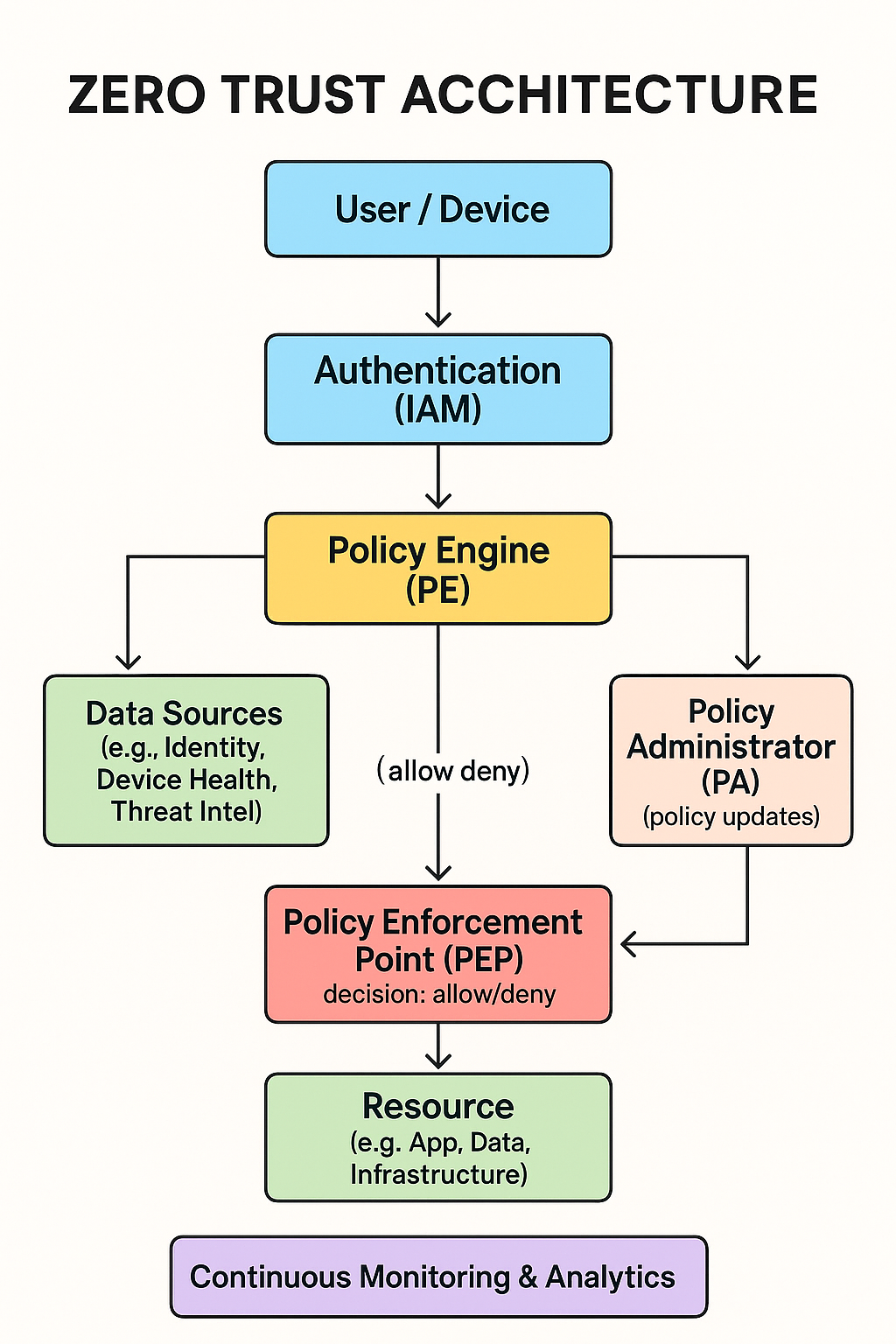
Example: Securing an API Gateway with OPA
Let's implement a policy for the Policy Decision Point (PDP). In this scenario, access to a sensitive API endpoint requires that the user has authenticated with MFA and is using a company-managed, compliant device.
Step 1: The External Data
The PDP is loaded with external data about device compliance. This could be synchronized from an MDM solution.
// device_db.json
{
  "devices": {
    "device-1122": { "is_compliant": true, "os_version": "14.5" },
    "device-3344": { "is_compliant": false, "os_version": "12.1" }
  }
}
Step 2: The Context-Aware Policy (Rego)
The Policy Enforcement Point (e.g., your API Gateway) sends the user's JWT and device ID to OPA. The policy inspects both to make a decision.
package zero_trust.api
import rego.v1

default allow = false

# The main rule combines multiple checks
allow if {
    mfa_completed
    device_is_compliant
}

# Helper rule to check the JWT for an MFA claim
mfa_completed if {
    # 'input.jwt.amr' is the list of auth methods from the token
    "mfa" in input.jwt.amr
}

# Helper rule to check the device DB
device_is_compliant if {
    # 'input.device_id' is passed from the PEP
    device_id := input.device_id
    data.devices[device_id].is_compliant == true
}
Enforcement at Every Layer
Zero Trust isn't just for user authentication. The same principles should be applied to your network and data layers.
Network Policies (Micro-segmentation)
Deny all network traffic by default, even between services in the same VPC. Use Kubernetes NetworkPolicies or cloud security groups, governed by policy-as-code, to explicitly allow only the necessary communication paths (e.g., "the `webapp` service can talk to the `auth-service` on port 8080").
Data Access Policies
The final layer of defense. Policies should govern who can access what data, even if they have network access. For example, an S3 bucket policy should restrict access not only to a specific IAM role but also require that the role has an active MFA session and is coming from a trusted IP range.
Best Practices
💡 Key Takeaways
- Start with Visibility: Before enforcing, run your Zero Trust policies in an advisory or "audit" mode to understand current access patterns and avoid disrupting legitimate traffic.
- Unify Your Policy Engine: Use a single policy engine (like OPA) as the PDP across multiple enforcement points (API gateways, service meshes, hosts) for consistency.
- Rich Context is Key: A Zero Trust decision is only as good as the data it's based on. Invest in robust identity, device, and resource metadata systems to feed your PDP.
- Focus on Service-to-Service First: While user access is important, the majority of traffic in modern architectures is between microservices. Start by applying Zero Trust principles to your internal service communication.
- Automate Everything: Manually managing Zero Trust is impossible. The entire lifecycle—from policy authoring and testing to deployment and decision logging—must be automated.