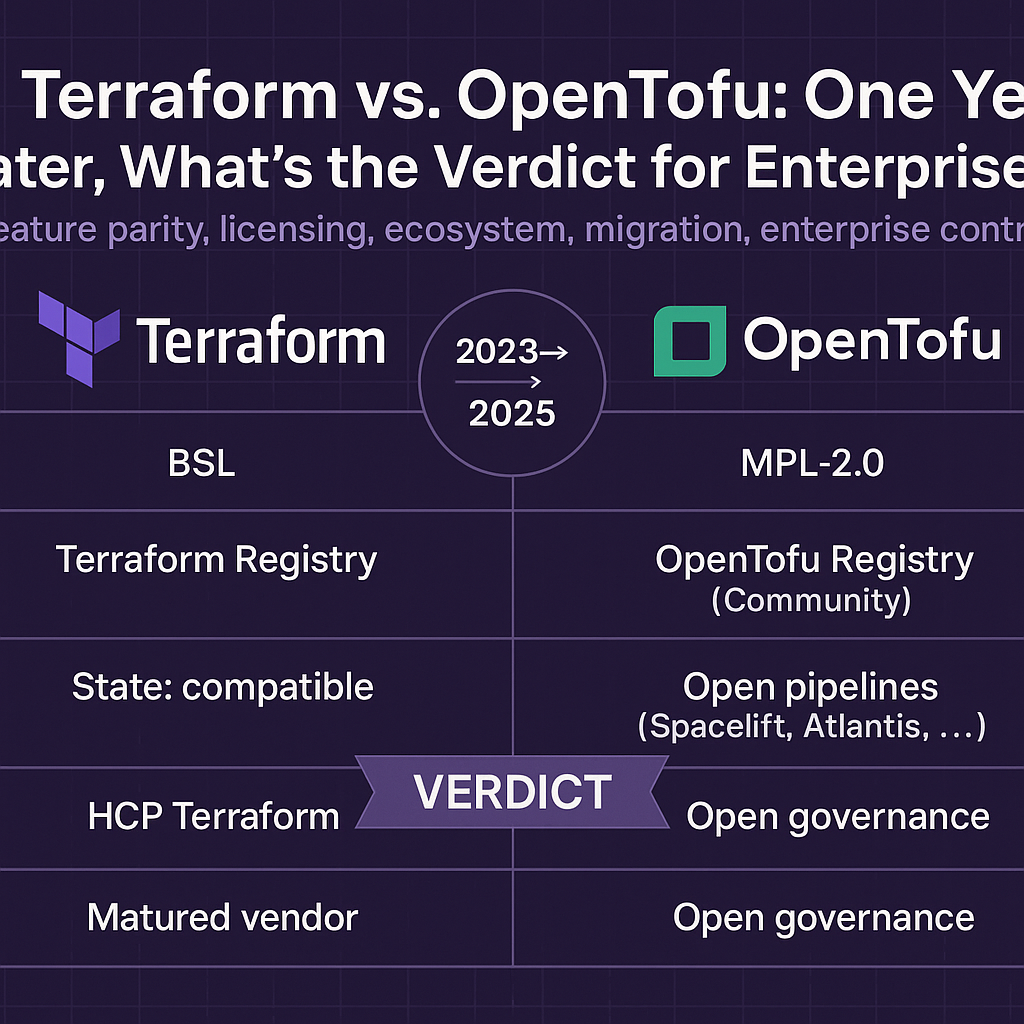
It's been over a year since HashiCorp's seismic shift from the Mozilla Public License (MPL 2.0) to the Business Source License (BUSL 1.1) for Terraform. The move sparked intense debate and led to the creation of OpenTofu, a CNCF-hosted, community-driven fork. The dust has now settled, and enterprises are asking a critical question: which tool is the right strategic choice for 2025 and beyond?
This isn't just a technical debate; it's a strategic one about risk, innovation, and the future of open source. This guide provides a clear, unbiased verdict for enterprise decision-makers, comparing the two projects on licensing, feature velocity, ecosystem, and support.
📊 The IaC Landscape in Late 2025
📋 Table of Contents
⚖️ Criterion 1: Licensing and Commercial Implications
This is the issue that started it all. For most enterprises that simply use Terraform to manage their own infrastructure, the practical impact is minimal. However, the philosophical and long-term implications are significant.
Terraform (BUSL 1.1)
- What it means: You can use Terraform for free for any internal purpose. You cannot, however, build a commercial product that directly competes with HashiCorp's offerings (like Terraform Cloud).
- For Enterprises: If you are a typical bank, retailer, or healthcare company, the license does not restrict you. If you are a vendor that provides a commercial DevOps platform, it likely does.
🚀 OpenTofu (MPL 2.0)
- What it means: It is a truly Free and Open Source Software (FOSS) license. There are no restrictions on use, modification, or commercial embedding.
- For Enterprises: Guarantees the tool will remain open source forever, governed by the community via the CNCF. This eliminates the risk of future, more restrictive license changes from a single vendor.
✨ Criterion 2: Feature Velocity and Innovation
A year on, we are beginning to see divergence. While both tools share a common ancestry, their development priorities are starting to differ.
- Terraform: Innovation is driven by HashiCorp's product roadmap. Recent focus has been on deeper integration with Terraform Cloud, enterprise-focused features like drift detection, and improvements to the testing framework. Development is high-quality but centrally controlled.
- OpenTofu: Innovation is community-driven. A key feature introduced in OpenTofu is client-side state encryption, a long-requested feature for enhanced security. The community is also focused on improving the extensibility of the core and ensuring the planning and output formats remain predictable for wrapper tools.
🌐 Criterion 3: Ecosystem and Provider Compatibility
The single greatest strength of Terraform has always been its vast provider ecosystem. The fear was that a fork would fragment this.
The Registry Situation
# Terraform uses the official HashiCorp Registry
terraform {
  required_providers {
    aws = {
      source  = "hashicorp/aws"
      version = "~> 5.0"
    }
  }
}

# OpenTofu uses its own registry, which is a fork of the original
# For now, it is a near-perfect mirror for most providers.
terraform { # The block is still named 'terraform' for compatibility
  required_providers {
    aws = {
      source  = "hashicorp/aws" # The source remains the same
      version = "~> 5.0"
    }
  }
}
Currently, the OpenTofu registry maintains compatibility with the vast majority of Terraform providers. Most community modules work on both with no changes. The long-term risk is divergence, but for now, the ecosystem remains largely unified from a user's perspective.
🏢 Criterion 4: Enterprise Support and Stability
For large organizations, commercial support is non-negotiable.
- Terraform: Offers a clear, single-vendor support model through HashiCorp's Terraform Cloud and Enterprise offerings. This is a mature, proven platform with a global support organization.
- OpenTofu: Support comes from a coalition of vendors who are building the project (e.g., Gruntwork, Spacelift, Harness, etc.). This multi-vendor model offers choice but can be more complex to navigate than a single-vendor solution.
➡️ The Migration Path: How Hard Is It to Switch?
For now, migrating from Terraform to OpenTofu is trivial for most use cases, as the core language and state files are compatible.
A Typical Migration Workflow
# Step 1: Install the OpenTofu binary
brew install opentofu

# Step 2: Navigate to your existing Terraform project
cd my-terraform-project/

# Step 3: Run 'tofu init' instead of 'terraform init'
tofu init

# Step 4: Run 'tofu plan' and 'tofu apply'
tofu plan
tofu apply

# Your existing state file and configuration will work seamlessly.
🎯 Key Takeaways for Enterprises
- Licensing: The BUSL license is not a direct threat to most enterprise users, but OpenTofu's MPL license eliminates future risks and vendor lock-in concerns.
- Compatibility: For now, the tools are almost entirely compatible. Migration is easy, and most providers/modules work on both.
- Innovation: Terraform's innovation is tied to its commercial offerings. OpenTofu's is driven by community and vendor collaboration, leading to different features (e.g., client-side state encryption).
- The Verdict: The choice depends on your organization's philosophy.
- Choose Terraform if you value a mature, single-vendor ecosystem and are already invested in Terraform Cloud.
- Choose OpenTofu if you prioritize a truly open-source future, want to avoid vendor lock-in, and value community-driven features.
🔮 Future Outlook
Expect the two projects to diverge more significantly in the coming years. The key battleground will not be the core language, but the provider ecosystem and the features of their respective commercial platforms. For enterprises, the best strategy is to build modular, portable IaC that could, if necessary, be adapted for either tool.