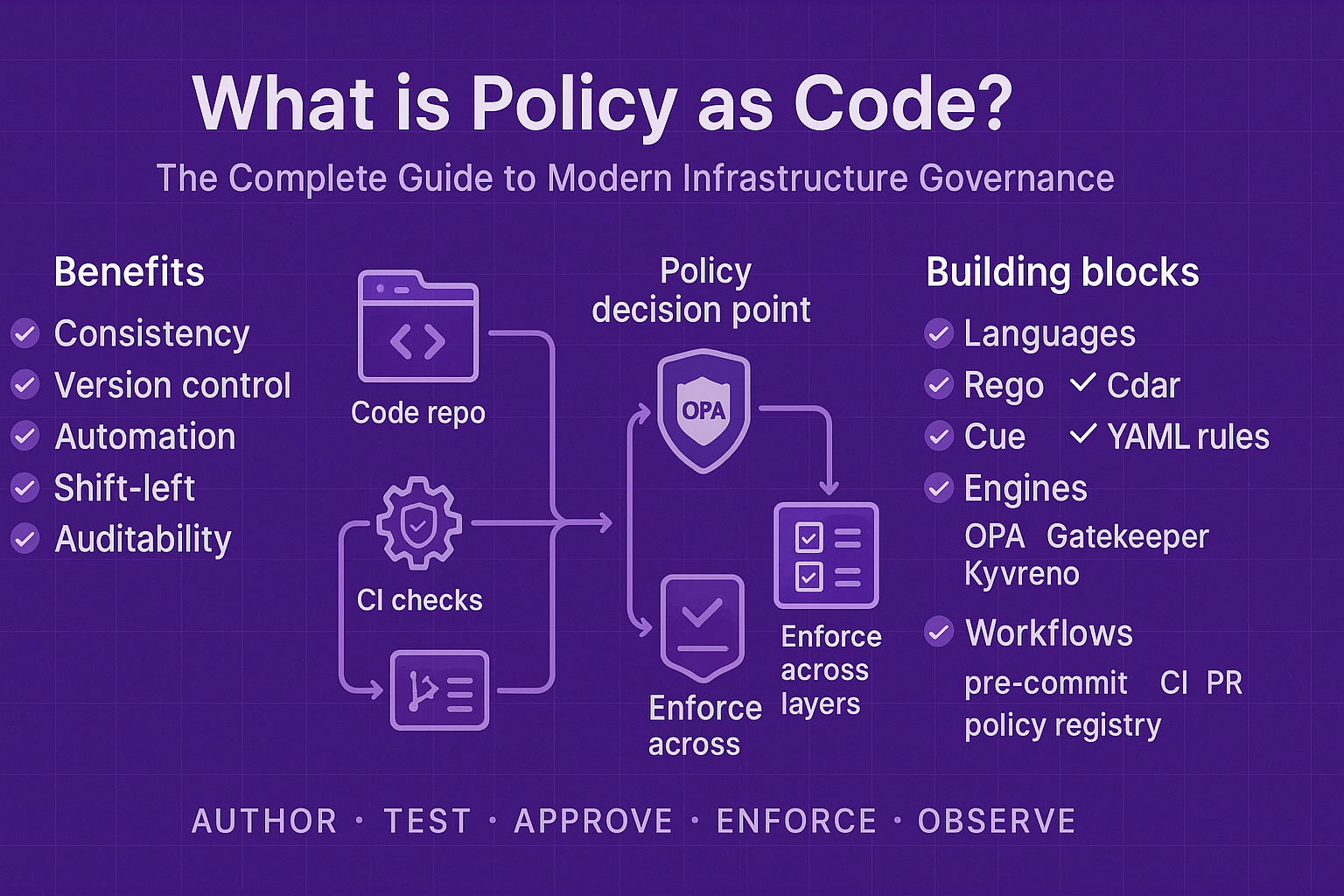
In the age of cloud-native development, organizations deploy infrastructure changes hundreds of times per day. But how do you ensure every deployment meets your security, compliance, and operational standards without slowing down innovation? The answer is Policy as Code (PaC)—the practice that's revolutionizing how modern teams govern their infrastructure at scale.
📋 Table of Contents
🤔 The Problem: Why Traditional Governance Fails
Picture this: a developer needs to deploy a new service. In a traditional model, this triggers a cascade of manual reviews—security teams checking firewall rules, compliance officers verifying data handling, and operations validating resource tags. Each review is a bottleneck, turning rapid deployment into a multi-week process. This friction creates a culture where developers either slow down or try to bypass the rules altogether.
This is the infrastructure governance paradox: the faster you need to move, the more important governance becomes, yet traditional methods inherently slow you down.
For a real-world example, consider the 2019 Capital One data breach, where a misconfigured AWS S3 bucket exposed sensitive customer data. Manual reviews failed to catch the issue, leading to a massive security incident that could have been prevented with automated policy enforcement in the deployment pipeline.
🚀 What is Policy as Code? An Analogy
Policy as Code (PaC) is the practice of defining, versioning, and enforcing infrastructure governance rules as executable code. Instead of static documents, you write policies in languages that can be automatically tested and enforced.
The Skyscraper Analogy
- Infrastructure as Code (IaC), like Terraform, provides the blueprints for a skyscraper.
- Policy as Code (PaC), like OPA or Sentinel, is the automated building inspector that checks those blueprints against the city's building codes (security, compliance, cost) before construction begins.
Beyond the analogy, PaC is used in scenarios like ensuring all cloud resources are tagged for cost allocation or blocking deployments that violate regulatory standards such as GDPR or HIPAA. For instance, a financial services company might use PaC to enforce encryption on all data storage resources automatically.
🔄 How it Works: The Policy Enforcement Lifecycle
Policy as Code isn't a single action; it's a continuous process integrated across the entire development lifecycle. This "shift-left" approach catches issues early, when they are cheapest and easiest to fix.
Let's dive into real-world examples for each stage:
- IDE & Pre-commit: Using the OPA extension in VS Code, developers can validate Terraform code locally. For instance, a pre-commit hook runs OPA to check if an S3 bucket is set to public, providing immediate feedback.
- CI Pipeline: In a GitHub Actions workflow, integrate OPA to scan IaC before merging. Here's a sample YAML snippet:
Example: Checking a Terraform Plan in GitHub Actions
# .github/workflows/terraform-plan.yml
name: Terraform Plan and Policy Check
on: [pull_request]
jobs:
  plan:
    runs-on: ubuntu-latest
    steps:
      - uses: actions/checkout@v4
      - uses: hashicorp/setup-terraform@v3
      - name: Terraform Init
        run: terraform init
      - name: Terraform Plan
        run: terraform plan -out=tfplan.binary && terraform show -json tfplan.binary > tfplan.json
      - name: OPA Policy Check
        run: |
          opa eval --input tfplan.json --data policies/deny_public_s3.rego \
            "data.aws.s3.deny"
- Admission Control: In Kubernetes, tools like Kyverno or OPA Gatekeeper act as admission controllers to mutate or reject pods that don't meet policies, such as requiring specific labels.
- Runtime: Use OPA with tools like Falco for ongoing monitoring, alerting on drift like unexpected privilege escalations in running containers.
🛠️ The Tooling Landscape: OPA, Sentinel, Kyverno, and More
The Policy as Code ecosystem is mature, with several powerful tools leading the way. The right choice depends on your existing tech stack and use case. Here are detailed examples for the three most popular tools:
Open Policy Agent (OPA) with Rego
Use Case: The general-purpose, open-source standard. Works with anything: Terraform, Kubernetes, microservices, etc.
Language: Rego (a powerful declarative query language).
Strength: Unmatched flexibility and a massive ecosystem.
# policies/deny_public_s3.rego
package aws.s3

deny[msg] {
    input.resource_changes[_].change.after.acl == "public-read"
    msg := "Public S3 buckets are not allowed"
}
HashiCorp Sentinel
Use Case: Tightly integrated with the HashiCorp ecosystem (Terraform, Vault, Consul).
Language: Sentinel (a policy language with a simpler, more imperative feel).
Strength: Seamless integration if you're a heavy Terraform Cloud/Enterprise user.
# policies/restrict_instance_types.sentinel
import "tfplan/v2" as tfplan

allowed_types = ["t2.micro", "t2.small"]

main = rule {
  all tfplan.resource_changes as _, rc {
    rc.type == "aws_instance" and
    rc.change.after.instance_type in allowed_types
  }
}
Kyverno
Use Case: Kubernetes-native policy management.
Language: Policies are defined directly in Kubernetes-style YAML.
Strength: Lower learning curve for teams already familiar with Kubernetes manifests.
# require-labels.yaml
apiVersion: kyverno.io/v1
kind: ClusterPolicy
metadata:
  name: require-team-label
spec:
  validationFailureAction: Enforce
  rules:
  - name: check-for-team-label
    match:
      any:
      - resources:
          kinds:
          - Pod
          - Deployment
          - Service
    validate:
      message: "The label 'team' is required for all resources."
      pattern:
        metadata:
          labels:
            team: "?*"
Kyverno: Restrict Privileged Containers
# restrict-privileged-containers.yaml
apiVersion: kyverno.io/v1
kind: ClusterPolicy
metadata:
  name: restrict-privileged-containers
spec:
  validationFailureAction: Audit
  rules:
  - name: validate-privileged
    match:
      resources:
        kinds:
        - Pod
    validate:
      message: "Privileged containers are not allowed."
      pattern:
        spec:
          containers:
          - securityContext:
              privileged: false
Kyverno: Require Resource Requests & Limits
# require-requests-limits.yaml
apiVersion: kyverno.io/v1
kind: ClusterPolicy
metadata:
  name: require-requests-limits
spec:
  validationFailureAction: Enforce
  rules:
  - name: validate-requests-limits
    match:
      any:
      - resources:
          kinds:
          - Pod
    validate:
      message: "CPU and memory requests and limits are required."
      pattern:
        spec:
          containers:
          - resources:
              requests:
                memory: "?*"
                cpu: "?*"
              limits:
                memory: "?*"
                cpu: "?*"
📈 The Benefits of Adopting Policy as Code
Implementing PaC is a strategic investment that pays dividends across security, operations, and development.
Real-world case studies highlight these benefits:
- Netflix with OPA: Netflix uses OPA for unified authorization across microservices, reducing security risks and enabling faster feature deployments by automating policy decisions.
- Atlassian with OPA: Atlassian implemented OPA to scale authorization policies, improving collaboration between teams and ensuring consistent governance in their cloud infrastructure.
- Large Financial Institution with Kyverno: A major Asia Pacific bank adopted Kyverno for Kubernetes policy enforcement, resulting in improved security posture, streamlined compliance, and enhanced developer productivity by automating checks for pod security, resource optimization, and supply chain security.
- NVIDIA DGX Cloud with Kyverno: NVIDIA enforces Kubernetes Pod Security Standards using Kyverno, maintaining secure AI workloads and reducing operational overhead.
- Leading Global Bank with Sentinel: A Fortune 500 bank integrates Sentinel with Terraform to enforce infrastructure policies, reducing risk during cloud migrations and accelerating service delivery.
- Reduced Risk: Automatically prevents common misconfigurations that lead to security breaches and compliance violations.
- Increased Velocity: Replaces slow manual reviews with high-speed automated checks, allowing developers to deploy faster and with greater confidence.
- Improved Collaboration: Creates a shared language and understanding of governance rules between Development, Security, and Operations (DevSecOps).
- Automated Audit Trails: Every policy decision is a code-based event that can be logged and audited, simplifying compliance reporting.
🎯 Key Takeaways
- Policy as Code transforms governance from a manual bottleneck into an automated enabler.
- It "shifts security left," catching issues in the CI pipeline, not in production.
- Start with a few high-impact policies (e.g., block public S3 buckets) and expand coverage over time.
- Choose tools that fit your ecosystem and empower developers, rather than hindering them.
- PaC is not just for compliance—it's a critical practice for enabling innovation securely and at scale.
🔮 The Future of Policy as Code
The PaC landscape is rapidly evolving. The next wave will be driven by AI-assisted policy authoring, where developers can describe a security requirement in plain English and have the corresponding Rego or Sentinel code generated. Additionally, expect tighter integration with runtime security tools for creating policies that not only prevent bad configurations but also respond to active threats.