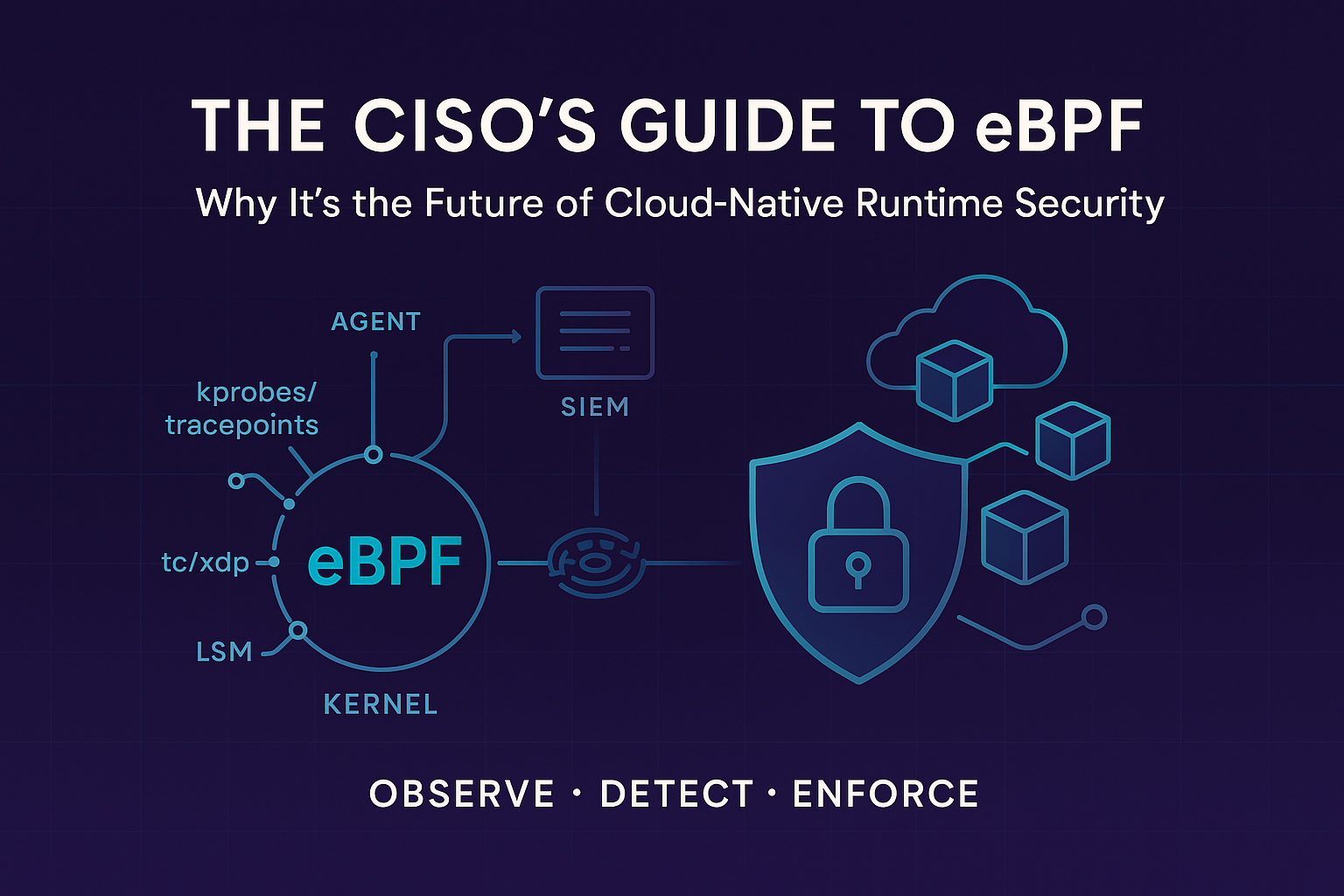
As a security leader, you're responsible for managing risk in an increasingly complex cloud-native landscape. Traditional security tools struggle to provide visibility inside the "black box" of the Linux kernel, leaving critical gaps in your runtime security posture. eBPF is the disruptive technology that solves this problem.
eBPF is not just another tool—it's a fundamental shift in how we secure and observe cloud-native systems. It provides kernel-level visibility without the performance overhead or security risks of traditional agents and sidecars. This guide explains what eBPF is in business terms and provides a strategic framework for its adoption.
📊 eBPF Adoption & Impact (2025)
📋 Table of Contents
🤔 What is eBPF and Why Should a CISO Care?
In simple terms, eBPF (extended Berkeley Packet Filter) is a technology that allows you to run sandboxed programs directly inside the Linux kernel without changing kernel source code or loading kernel modules.
Analogy: Think of it like secure, event-driven JavaScript for your operating system's kernel. When an event happens (like a file is opened, a network connection is made, or a process is executed), your eBPF program can securely observe and act on it.
For a CISO, this means you can finally get granular, real-time visibility into every action happening inside your production environments. This capability is the foundation of modern runtime security, threat detection, and network policy enforcement.
🔄 Replacing Legacy Tools: Sidecars vs. eBPF
For years, the standard for adding security and observability to Kubernetes was the "sidecar" model. This model has significant drawbacks that eBPF solves.
Architectural Comparison
# Traditional Sidecar Model
- Con: High resource overhead (doubles container count).
- Con: Adds network latency for all traffic.
- Con: Blind to host-level and kernel-level threats.

# eBPF Model
- Pro: Near-zero resource overhead.
- Pro: Kernel-level visibility sees everything on the host.
- Pro: More secure and tamper-proof.
🎯 Key Security Use Cases for eBPF
eBPF is an enabling technology for a new generation of security tools. Its primary use cases include:
🚀 Top CNCF Projects Leveraging eBPF
The maturity of the eBPF ecosystem is best demonstrated by the powerful CNCF-graduated projects that use it as their foundation:
- Cilium: Provides networking, observability, and security for cloud-native environments using eBPF.
- Falco: A runtime security tool that acts as a "security camera" for your applications, detecting and alerting on anomalous behavior.
- Tetragon: A security observability and runtime enforcement tool built on eBPF, providing deep visibility and real-time policy enforcement.
💼 Building a Business Case for eBPF Adoption
When presenting eBPF to executive leadership, focus on these key business outcomes:
🎯 Key Takeaways
- eBPF Provides Unparalleled Visibility: It offers deep, kernel-level insight into your systems, closing security gaps left by traditional tools.
- It Reduces Cost and Complexity: By eliminating the need for sidecar containers, eBPF-based tools significantly lower the resource overhead of your clusters.
- It's the Industry Standard: eBPF is a mature, CNCF-backed technology that is the foundation for modern cloud-native security and networking.
- It Enables a Proactive Security Posture: The rich, contextual data from eBPF allows security teams to move from reactive alerting to proactive threat hunting and faster incident response.
🔮 Future of eBPF
The next frontier is combining the rich, high-fidelity data stream from eBPF with AI and Machine Learning. By feeding this data into AI models, security platforms will be able to detect novel, zero-day threats with unprecedented accuracy, moving from reactive alerting to predictive security.